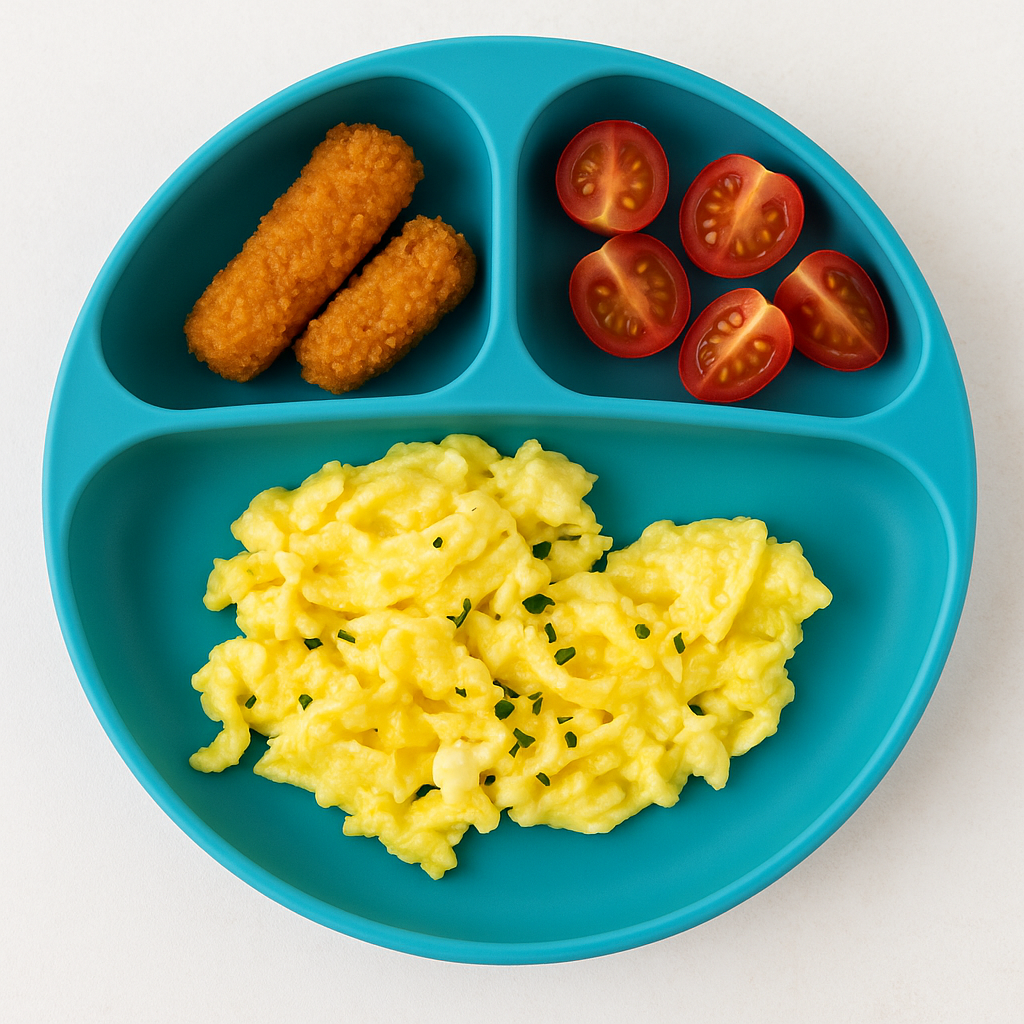
You’re going to get bored of making and eating your initial efforts to cook your kiddo(s) eggs; your child, particularly as he/she transitions from infant to toddler, will be looking for something else, too. When you’re ready to experiment, here’s a great Eggs 2.0: it hits all the creamy and gooey notes your kiddo craves while providing you the satisfying morning pick-me-up you’ve been craving. The secret, it turns out, is dairy: for you, using cottage cheese or yogurt functions not unlike feta cheese would in a Greek-style omelet; for your kiddo, it turns eggs into something like grilled cheese. Bonus: plenty of protein for both of you!
(Important before-we-begin note: unless using no-sodium cottage cheese, do not salt these eggs! Plenty of salt in there from the soft cheese already.)
Ingredients Overview
- Egg – The base ingredient, offering high-quality protein and essential nutrients ideal for a baby or toddler’s growing body.
- Cottage cheese or yogurt – Adds creaminess, calcium, and extra protein; makes the texture softer, more tender, and easier for little mouths to handle than plain scrambled eggs.
- Dried chives (or other mild herbs) – Mild flavor boost that helps make the eggs more interesting without overwhelming sensitive young palates.
- Optional shredded cheese – For additional richness, calcium, and flavor — useful especially when introducing eggs to infants or toddlers for the first time.
- Olive oil (or mild cooking fat) – Helps cook the eggs gently, producing tender curds with minimal sticking or over-browning.
Steps Summary
- Prep the egg mixture — In a small bowl, combine one egg with a spoonful of cottage cheese or yogurt, add a pinch of herbs (like dried chives), and lightly season if using yogurt (skip added salt if using no-sodium cottage cheese).
- Heat your pan and oil — Warm a small pan over high heat, then pour in a generous swirl of olive oil and heat briefly.
- Cook the eggs — Pour in half of the egg mixture so it spreads into a thin layer. As the eggs begin to set, fold the edges toward the center until everything piles into a soft “slab.” If using cheese, add it before folding.
- Finish gently — Lower heat to medium-low, flip the slab, cook for about a minute until done but still soft. Then remove from heat and let rest to cool slightly.
- Cut and serve toddler-style — Once cooled enough to handle, cut the egg slab into strips or small bite-sized pieces for infants or toddlers. Serve with a side of fruit, yogurt, or soft toast depending on your child’s age and skills.
FAQ
Q: How old should a baby be before trying this egg recipe?
A: Once your baby has successfully had cooked egg in simple form (pureed or finely chopped) and is tolerating dairy (if you’re using cottage cheese or yogurt), this recipe offers a soft, easy-to-chew texture that works well for many infants transitioning to solids.
Q: Do I need to salt the eggs?
A: Not if you’re using cottage cheese (especially no-sodium) — the curds bring enough saltiness and moisture on their own. If you use yogurt, a tiny pinch of salt (or none) is fine, especially for very young eaters.
Q: What if my child has a dairy sensitivity?
A: You can skip the cottage cheese/yogurt and use a splash of formula or breastmilk (if age-appropriate) to keep the eggs soft. The folding technique still yields tender curds that are easy to chew.
Q: Can I make a bigger batch for multiple breakfasts?
A: Yes — scale the eggs and dairy proportionally, then cook in a larger pan or split into multiple small pans. After cooking, slice into strips and refrigerate; you can warm gently or serve cold depending on your child’s preference.
Q: How do I serve the eggs to encourage self-feeding?
A: Cut into strips or small chunks, and pair with soft fruits or toast strips. The mild flavor and tender texture make them easy for little hands and new eaters to grasp and chew.
Related Links
More Toddler-Friendly Egg Recipes
And check out all of our great toddler breakfast recipes!